PLURI (Plurilingualism for Better Education, Cohesion and Linguistic Diversity) is a two-year European project co-funded by the European Union. It explores how multilingualism can become a more visible and natural part of education and everyday community life. Many people use more than…
Language is much more than just a tool for exchanging information. It is connected to family, memory, a sense of belonging, education, identity, and how we participate in society. Europe is highly multilingual. Alongside national and regional languages, people use hundreds of…
PLURI combines digital tools, art-based methods, participatory research and practical, community-based work to promote positive perceptions of language diversity. A key element of our approach is participatory action research. This means that educators, families, students, researchers and community organisations are not merely…
PLURI is a two-year project based on the principle that meaningful change is more likely to happen when those affected by an issue are involved in developing the response. This is why our activities are interconnected. For example, a question may arise…
PLURI brings together people from research, education, the arts and community-based practice. Our collaboration grew out of an earlier Erasmus+ project, LangWork, and a shared interest in making linguistic diversity more visible in education and public life. The project is built on…
During PLURI scientific seminars the team connects with researchers working on topics related to multilingualism, translanguaging and education to exchange knowledge and discuss questions emerging from the project. PLURI creates a space to connect current research with experiences and insights from PLURI’s practical activities.
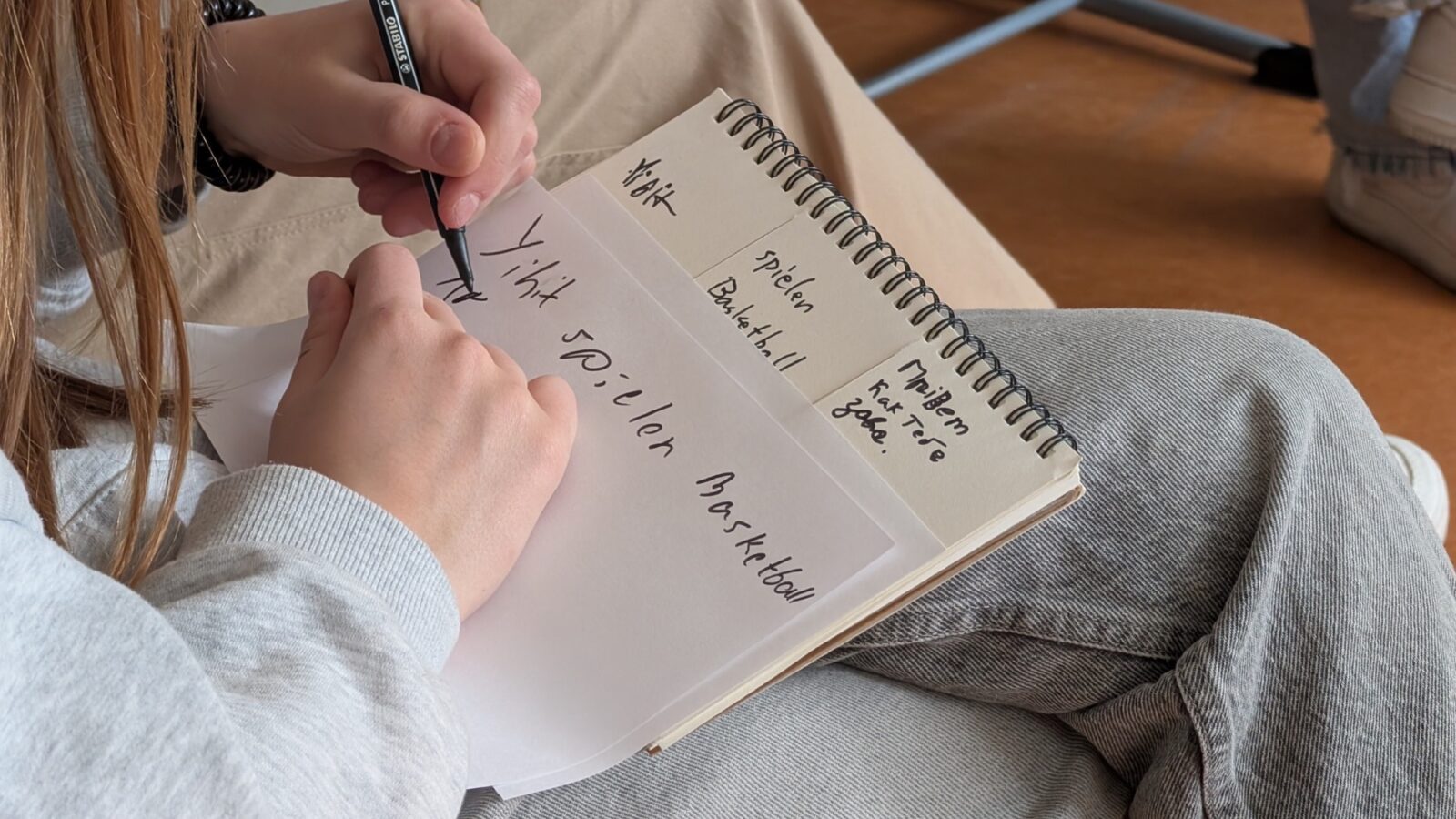
In home-made fold books, several people write sentences together. By passing on and folding over, words, languages, slang and signs keep combining in new ways. Afterwards, the language material that has been created is looked at together.
What you need
Prepared fold books, pens, slips of paper for the mini poems.
Preparation:
Cut thin landscape-format sketchbooks with a cutter and ruler into three flaps of equal width. Spine and binding stay intact.
How it works
Start in the middle: Sit in a circle. Everyone writes a verb on the middle flap – for example on the question “What do you like doing?” or “What annoys you?”. It doesn’t always have to fit grammatically later.
Pass on, add, turn over: Pass the book on. Add to the visible part on a free flap, then turn the page so that the next person again sees a free flap and part of the previous sentence.
Add new rules: After a few rounds, new rules come in, for example: use at least one word backwards; at least one symbol instead of a word; at least one word from another language; at least one word from youth language or a slang you know. More rules are possible – invent your own.
Combine and read aloud: Flip freely through the fold book and combine left, middle and right flaps into new sentences. Choose three and read them as a mini poem.
Look together: Lay out or hang up the chosen sentences and look at the collection together.
What does the practice open up?
The fold book sets language in motion. Nobody writes a sentence alone; parts stay hidden and are recombined. Chance and collective writing create new meanings. Different languages, slang, signs and spellings can mix. Looking at it together shows what a group uses, chooses or understands.
Start a conversation & think further
Look at the sentences together:
What do you notice?
What surprises you?
Which languages, words and expressions appear – and which don’t?
What to watch out for
Start the conversation from what has actually been created. Multilingualism does not have to be demanded. If hurtful or discriminatory terms appear, the matching impulse card can support the conversation.
Variations
Write on a shared topic.
In small groups, lay out a common poem from several sentences.
Continue the fold books across several sessions or groups.
Cookies & external content
We only use technically necessary storage, for example to remember the selected language. External content such as videos from YouTube or audio from Spotify is only loaded after consent – data is then transferred to these providers. The choice can be changed at any time via “Cookie settings” in the footer. Privacy policy